
I am attending a panel on policing at the Battle of Ideas on October 19th 2025 so I thought I would start now to marshal my thoughts and reactions to the current state of our policing. My focus is on the police’s inability to handle on line discussions around sex v gender and the continued weaponization of perception based recording. The problem is of course wider; police reactions - or failure to react - to other situations that reflect political ideologies are fuelling concerns that we have a de facto ‘two tier’ policing system, which is propped up by a reasonable perception that the police offer unlawful adherence to one ideology over another.
I was embarrassingly wrong
It really did feel like being part of something exciting and vital in 2019 when Knowles J ruled that Humberside Police had acted unlawfully to visit Harry Miller’s place of work to ‘check his thinking’ over his shockingly controversial view that its not possible to change sex. The Court of Appeal in 2021 went on to declare that the whole scheme of Non Crime Hate Incidents as applied to Miller was also unlawful, followed by a Parliamentary Code of Practice in June 2023 to remind the police to use common sense, be aware of likely malicious complaints and to respect article 10 ECHR (right to free speech).
I thought we had achieved complete victory over this malign ideology of ‘gender identity’ that appeared to have captured the police as a whole.
Not for the first time in my life I was utterly and embarrassingly wrong. The impact of the Court of Appeal judgment and the persistent criticisms and negative consequences of ‘perception based’ recording appear to have been ignored and as of 2025 the police are still continuing to record unchallenged, reports from the malicious and mentally unwell, so long as they fall within one of the five ‘monitored strands’ for hate crime - disability, race, religion, sexual orientation and transgender identity.
Depressingly, it’s now even worse than it was for Harry in 2019 as by 2025 we see the police willing to record as crimes, allegations that are not investigated and not communicated to the alleged perpetrator.
Introducing the Goon Squad
It will surprise no one of course to learn that the persistent and malicious abuse of this system comes from that final protected group, and in particular a small coterie of middled aged men who have managed to make a good part of the criminal justice system their dancing monkey.
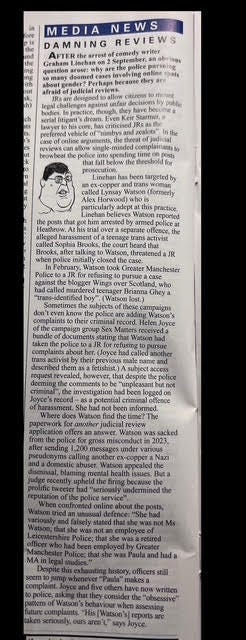
These men are Lynsay Watson, Stephanie Hayden, Freda Wallace and Michelle Burrows. Watson has been the most dangerous - as a former police officer he is able to game the system that he knows so well and alarmingly has even boasted that various police forces appear to be ‘subcontracting’ to him significant elements of the police investigation into alleged offences.
This is a useful precis of Watson’s activities from Private Eye who appear to have found their balls, so to speak, in recent months in reporting these issues. If you want a deeper dive, the Mail have done their research, along with Wings Over Scotland.
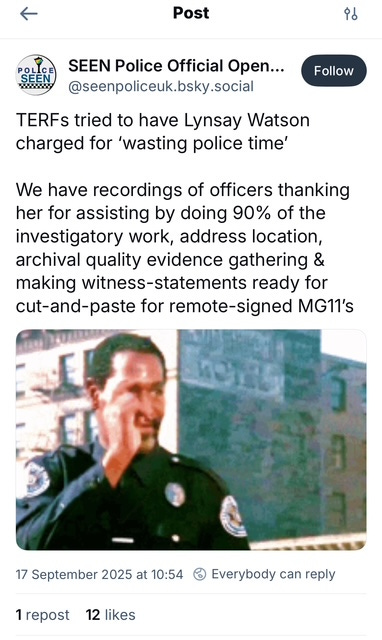
It is clear that Watson orchestrated the arrest of Graham Linehan in September 2025 as well as putting pressure on the police to charge him for offences relating to ‘Sophia Brooks’ by threatening judicial review when the police initially wished to take no further action. This may well be a pyrrhic victory for Watson and his Merry Men as Linehan’s arrest caused international outrage about the UK’s lack of respect for freedom of speech.
How did this happen?
I set down some initial thoughts here here about how we have got into this mess. I have given more thought to what exactly we will find swimming in this murky and toxic stew.
The near total capture of public bodies by the campaigning group Stonewall from about 2014 to 2023, which urged organisations to go ‘above the law’ and create ‘rights’ which simply do not exist; such as the ‘right’ not to be ‘misgendered’ or the ‘right’ of men to access single sex female spaces at will. Malcolm Clark discusses the capture of the police in particular here.
The continuing after effects of ‘Stonewall law’ in creating a culture which promotes the belief that ‘words are violence’ and thus the criminal law is rightly directed at tackling ‘hate speech’.
a motely collection of laws which attempt to fetter our exercise of free speech when set against the ‘alarm and distress’ of others, which with the exception of the Online Safety Act, all predate the rise of the internet. Online communication has seriously muddied the waters when it comes to assessing the imminence and reality of any expressed threat.
A mistaken belief by the police that they have no discretion when it comes to recording perception based crimes or incidents
The noble intentions of Macpherson, in accordance with the iron clad Law of Unintended Consequences, have been deliberately abused and weaponised to allow the frankly mentally ill to enjoy the police as their own private militia. The loss of trust and confidence in the police is widespread and serious. It took the High Court to tell them that marching with Progress Pride flags was a breach of their statutory duty of impartiality; it seems that Northumbria police were quite unable to understand the arguments presented in court.
But we don’t have a choice!
The Commissioner of the Metropolitan Police Sir Mark Rowley took to the airwaves after the arrest of Graham Linehan to call for the law to be changed as the police currently had no choice but to dance for their trans identifying masters. The technical legal term for this claim is ‘bollocks’. The police aren’t meat puppets. They are expected to engage their brains.
However, I can have some sympathy for the police when reading the Crime Recording Rules for Frontline Officers and Staff 2025/2026. This sets out at page 7 that the ‘crime recording steps’ are
The victim is to be believed
On the balance of probability has a crime in law been committed
There is no credible evidence which points to the crime not having been committed
However, the rules then state ‘it is important that any investigation which follows is taken forward with an open mind to establish truth’
So which is it? You cannot both ‘believe the victim’ and then ‘investigate with an open mind’. One cancels the other out. It is as if the Henriques Report never happened so no doubt we will and sometime soon repeat all the grim absurdities of Operation Midland, where delusional fantasies of wannabe victims of child sexual exploitation were treated as gospel truth from the outset and any ‘investigation’ treated as an annoying distraction.
The obvious approach to any person alleging a crime is to treat them seriously and to investigate.
I note a completely different approach to recording incidents, which reflects the Parliamentary Code of Practice- officers and staff must apply proportionality, common sense and discretion and consider the motivation of the person reporting (page 85). Why isn’t this the standard applied to reporting crime?
Helen Joyce set out in grim detail how she came to be reported and recorded as committing crimes against a trans identifying man and one fourth of the Goon Squad, Fred Wallace. The reporting person was of course, Lynsay Watson.
Joyce would never have known anything about this, had Watson not with his typical overreach, attempted a judicial review of the failure to charge Joyce with any crime. She was then sent paperwork alerting to her as to what had happened.
It seems Watson simply lied; claiming Joyce was responsible for abusive phone calls received by Wallace. The initial response was that Joyce had made ‘unpleasant’ but not criminal posts on social media and that the allegation about encouraging abusive calls could not be proved. A specialist on review disagreed, saying the victim had to be believed and that it should be recorded as a non crime hate incident. It went back to the first officer who decided to classify it as an actual crime - criminal harassment.
It could not proceed to a charging decision due to ‘evidential difficulties’, presumably the main one being that no one bothered to speak to Joyce and get her side of the story. Joyce’s name was recorded also, on the basis that her behaviour showed a real risk of significant harm or of committing further offences.
What value is this absurd recording to any attempt at reliable statistics? How many of us have been recorded as perpetrators of crime without being informed? I have already made my fourth request for my personal data from Wiltshire police and like Joyce, I will not be prepared to accept any such recordings against me.
What are the consequences of police capture?
It looks to me a lot like corroding trust and confidence in the police. This is a harbinger of a greater doom; the unravelling of the rule of law. I offer some examples of what has appeared on my ‘X’ feed in only the last few days. There are many, many more examples.
It is clear that people are now ready, willing and eager to believe the worst of the police. On 21st September the West Midlands Police had to issue a statement regarding a video of two police officers attending a child’s home that had been edited to mislead and suggest the police were concerned that the child had simply read a social media post. That so many were willing to be mislead cannot be simply dismissed as agitation by the ‘far Right’ when we examine the prevalence and inconsistency below. Both are high. The the police have to urgently examine their role in creating this reaction of hostility and fear.
Prevalence.
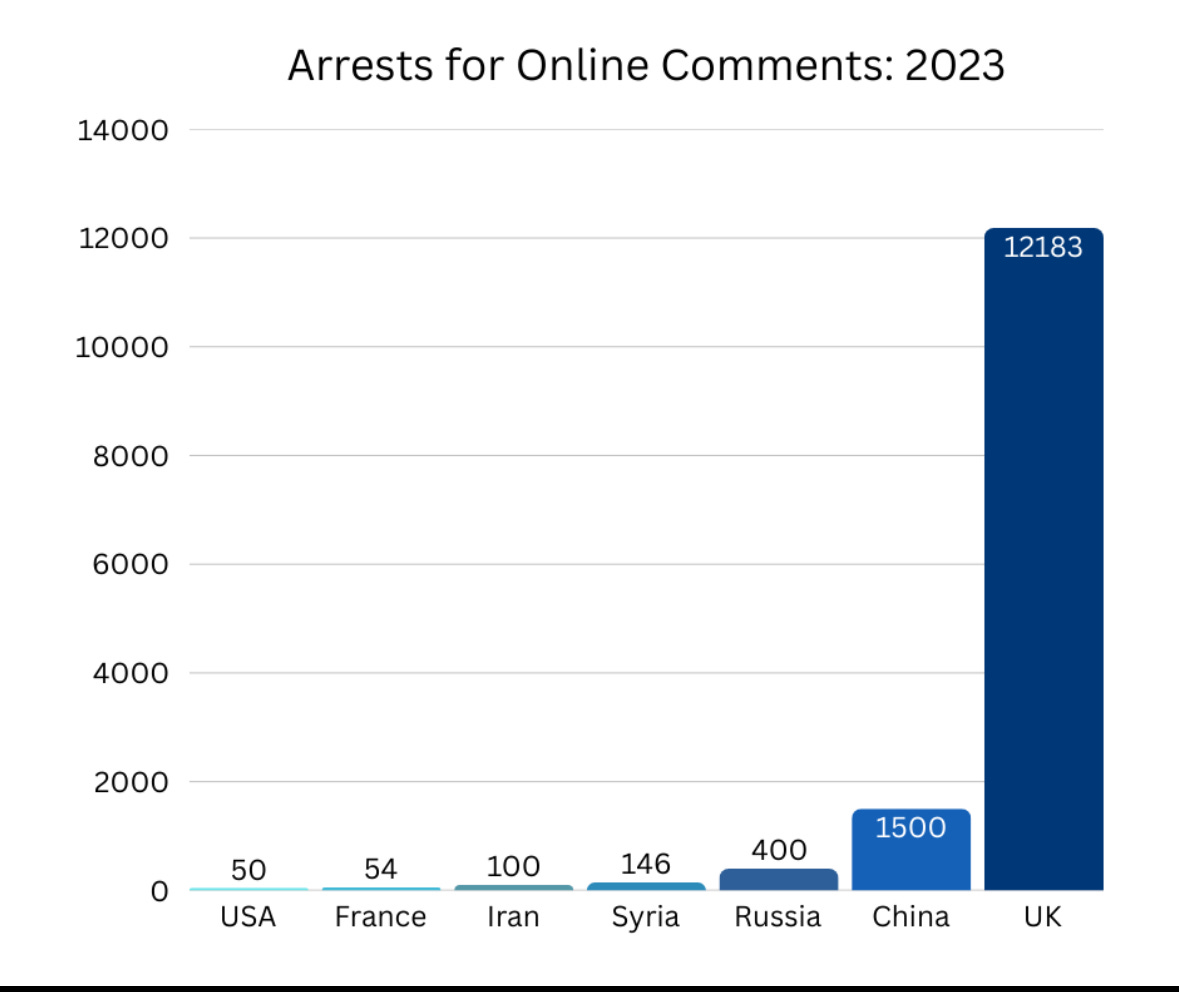
On September 18th 2025 Tommy Robinson posted to ‘X’ that the UK had by far the highest number of arrests for online comments out of 18 other countries. That information was put into handy graph form by Jennifer Gingrich.
It appears that these figures for the UK are correct and prompted concerned questions to the European Parliament in June 2025 that Brexit might be a contributing factor to the decline in free expression in the UK.
The ‘Stark Naked Brief’ account on ‘X’ posted on September 19th the response to a FOI request to Thames Valley Police, asking how many arrests they made under the Online Safety Act - 194 since October 2023. Add to this 939 arrests under the Communications Act and Malicious Communications Act and you get 1,068 speech-related arrests in a year.
These examples contrast very badly with figures around police intervention in other crimes. Compare the enthusiasm of TVP to dedicate police time to demanding apologies for hurty words on the internet, to the charging rate for rape.
The Oxford Mail reported in 2024 that only 50 charges followed 2,318 offences recorded - just 2.2%. The rate across England and Wales is 2.6%. The overall charge rate for all recorded offences was 6.4%. Rape offences took the longest time to investigate, at an average of 423 days.
Inconsistent responses
The police frequently let trans identifying men drown out women’s voices with amplified music. It may be unfair to include this as an ‘inconsistent response’ because of course women don’t attempt to prevent trans identifying men from meeting and speaking so we don’t have a point of comparison. Perhaps the police would happily let them? I raise a sceptical eyebrow. But there have been many recent and unambiguous examples of inconsistent police treatment of speech to prove my point; I will touch on just a handful.
On September 17th 2025 a video went viral on line when Deborah Anderson was visited at home by an officer from Thames Valley Police and told to apologise to someone she had upset on line. The officer would not tell her what she had said and offered her a choice between apologise or be arrested. The Free Speech Union stepped in and the police dropped it like it was hot, asserting on social media that ‘It is our duty to respond to allegations of threats or violence’. This will of course come as as surprise to the many gender critical women who have attempted police reports about threats and harassment by trans identifying men. The TVP statement was met with wide spread derision.
Rosie Duffield MP posted ‘As a legislator in @UKParliament, I did not recognise a single UK law that the officer in question was adhering to by making that house visit. Please can you point to me which piece of UK legislation you were acting on?’
And yet Charlotte Hayes, with 200K followers on TikTok did not attract any concern from Kent police after posting a video urging the murder of conservatives in the wake of Charlie Kirk’s murder, saying she was ‘sick of the idea that you can’t meet violence with violence… fucking kill them all, kill them all’. Turning Point UK confirmed on September 18th that Kent Police decided that no crime was committed.
I don’t think Charlotte Hayes should have faced criminal charges as her speech did not constitute a realistic or imminent threat, but Kent police’s lack of action contrasts uneasily with the forthcoming prosecution of Greg Hadfield. a former Sunday Times news editor who faces a criminal trial in November for posting on social media a screen shot of former Labour MP Ivor Caplin publicly engaging with pornography, in order to flag this concerning behaviour. Hadfield has been charged with sending an offensive message by a public communication network.
If he is caught by s127 of the Malicious Communications Act, why isn’t Ms Hayes? If the police are unable to explain why, this suggests either a problem with the law or their understanding of it.
The ‘vision’ for crime recording set out in the Crime Recording Rules is
That all police forces in England and Wales have the best crime recording system in the world: one that is consistently applied; delivers accurate statistics that are trusted by the public and puts the needs of victims at its core.
The ‘system’ we have now means nobody wins. The ‘statistics’ gathered are worthless.
Either Helen Joyce is a dangerous and persistent criminal whose behaviour is likely to escalate but the police have done nothing to stop her, other than writing it down or, and I suggest more likely, the man complaining about her is a dangerous, mentally ill liar who is using the police as an agent of his own harassment.
So what can be done?
I offer the following suggestions in no particular order of importance. Some I accept are ambitious - all are worth talking about if we want to restore public trust and confidence in the police and actually have a sensible approach to dealing with online threats and targeted harassment, which I accept can have a very harmful impact on genuine targets.
Urgent and immediate training for the police re the ambit of article 10; being offensive is not an offence - do they understand why? Never attend a person’s home to suggest they apologise for ‘upsetting’ someone online. I searched the Crime Recording Rules for mention of ‘free speech’ and ‘article 10’ - this returned zero results.
Recording standards for reported crimes and incidents must be the same - apply proportionality, common sense and discretion; consider the motivations of the person reporting.
Consider amending/consolidation of current laws relating to malicious communication to better reflect the internet age and the need to focus on imminent and realistic threats; not simply allowing people who experience a general sense of offence to weaponise those feelings via the criminal justice system. In light of Hadfield’s forthcoming prosecution, Section 127 of the Malicious Communications Act in particular is in need of an urgent overhaul.
As court decisions and Parliamentary guidance about the importance of Article 10 and data protection principles appear to have made little inroad into the collective consciousness of the police, we clearly need to consider amending the law relating to hate crime aggravators to make it clear that the police have a duty to look beyond mere perception based reporting, to assess if a complaint is trivial or malicious. While Mcpherson may have had a point in 1999, 26 years later the landscape is very different; perception based recording is no longer fit for purpose, given how easily it has been hijacked.
Do not record anything against a named person without telling them, unless this is part of a live investigation or a matter of national security
Do not ever record a crime against a named individual unless that person has been convicted after trial or pleaded guilty. Make it clear that what is being recorded is a report of an alleged crime. Make it clear why an individual is being named as the alleged perpetrator and record the individual’s response to that accusation
Agree that disclosure of any mere report will only be made if the alleged perpetrator is informed and given the opportunity to object
Likely malicious complainants such as Watson to be flagged
Conclusions
As Ezra Klein commented in his podcast on the 16th September - we are going to have to live here with each other. But we can’t allow the mad and lost a veto on what we can say, or hand over to them control of the police. It is clear that the internet both provides a stage and reward for unpleasant and insulting people. Some internet speech will need to face criminal consequences. But the law as it stands and is applied at the moment is not fit for purpose and will do far greater harm to the cohesion of society than any number of frothing trolls.
As Darryl Davis, Megan Phelps Roper and Charlie Kirk would attest - if Kirk were alive to do so - the only way out of bad thoughts and bad speech is more speech, to allow the bad thoughts to at least be challenged, rather than pushing people underground into yet deeper and darker echo chambers. I would rather have these people where I can read and hear what they say. If what I read and hear offends and upsets me, then I should not be able to call in the criminal justice system to forbid it, unless a high bar of imminent and realistic threat of harm has been met.
Wow, Sarah, what a takedown. Erudite, and pointed. Thank you for this. Excellent
Outstanding and damming essay.